
August 5, 2025
Trump targets banks that gave up Epstein clients
By Camaron Stevenson
The Trump administration announced plans Tuesday to penalize banks it believes are restricting services to clients for political reasons, two of which have provided the federal government with financial documents linking convicted sex offender Jeffrey Epstein’s alleged sex trafficking operation to his wealthy clients.
It’s those two banks, JPMorganChase and Bank of America, that President Donald Trump has repeatedly singled out when airing his grievances over being de-banked after his first term.
“The banks discriminated against me very badly, and I was very good to the banks,” Trump said in an interview on CNBC. “I’ll give you me as an example. I had hundreds of millions. I had many, many accounts loaded up with cash, loaded up with cash, and [JPMorgan] told me, ‘I’m sorry, sir, we can’t have you. You have 20 days to get out.’”
For years, the president has complained that he had been de-banked by large financial institutions for political reasons. He wasn’t; he was de-banked for inciting an insurrection. In 2021, 10 major financial institutions said they were closing accounts or pausing political donations to anyone closely involved in the Jan. 6 attack, mostly because government instability is bad for business.
But of those 10, Trump has only singled out the two US-based banks as the main targets of his executive order. And of those 10, only two that would be impacted by the order had Epstein as a client.
An ongoing US Senate Finance Committee investigation into Epstein uncovered thousands of suspicious activity reports on the convicted sex offender’s transactions from four banks: Deutsche Bank, Bank of New York Mellon, Bank of America, and JPMorgan. The suspicious activity includes massive overpayments to Epstein from billionaires for “tax services” and subsequent payments to Eastern European countries, where women who were trafficked to Epstein’s private island were from.
In the cases of JPMorgan and Bank of America, some of the reports weren’t filed until they were under the threat of scrutiny. Suspicious activity from the early 2000s wasn’t reported until after Epstein was arrested in 2019, and in at least three cases, not until after his death.
Oregon Sen. Ron Wyden, a ranking member of the committee, said investigators found a trail linking $170 million that went from Wall Street billionaire Leon Black to Epstein through Bank of America that can prove billionaires like Black financed Epstein’s trafficking operation.
In fact, the Wall Street billionaire actually admitted it in 2023: as part of a $62 million settlement with the US Virgin Islands, Black acknowledged that he knew his payments to Epstein were being used to “fund his operations in the Virgin Islands.”
“We felt from the beginning this was a follow-the-money case,” Wyden said in an interview with the New York Times. “This horrific sex-trafficking operation cost Epstein a lot of money, and he had to get that money from somewhere.”
JPMorgan left a similar legal paper trail. They settled a lawsuit in 2023 with Epstein’s victims for $290 million because the bank had been aware of suspicious activity with Epstein’s transactions, but didn’t report it for years. Later that year, they settled a lawsuit with the US Virgin Islands for $75 million in relation to Epstein’s sex trafficking. In both settlements, JPMorgan claimed no wrongdoing and took no civil responsibility.
“While the settlement does not involve admissions of liability, the firm deeply regrets any association with this man, and would never have continued doing business with him if it believed he was using the bank in any way to commit his heinous crimes,” JP Morgan said in a statement.
Investigators have not found a similar money trail linking billionaires to Epstein at Bank of New York Mellon. They have, however, been stalled indefinitely by the Trump administration, which revoked access to the US Treasury, where the suspicious activity reports are held. Republicans on the committee have declined Wyden’s request to issue a subpoena for the documents, further shielding them from scrutiny.
While Deutsche Bank also settled a multimillion-dollar lawsuit with Epstein’s victims, the exact impact Trump’s executive order would have on the bank, which is based in Germany, remains unclear.
But the other two, Bank of America and JP Morgan, both had Trump as a client while he was friends with Epstein, and have shown that, at the end of the day, they’ll hand over incriminating evidence, or otherwise do whatever they can to spare their shareholders, at the expense of clients like Epstein, Black, and Trump.
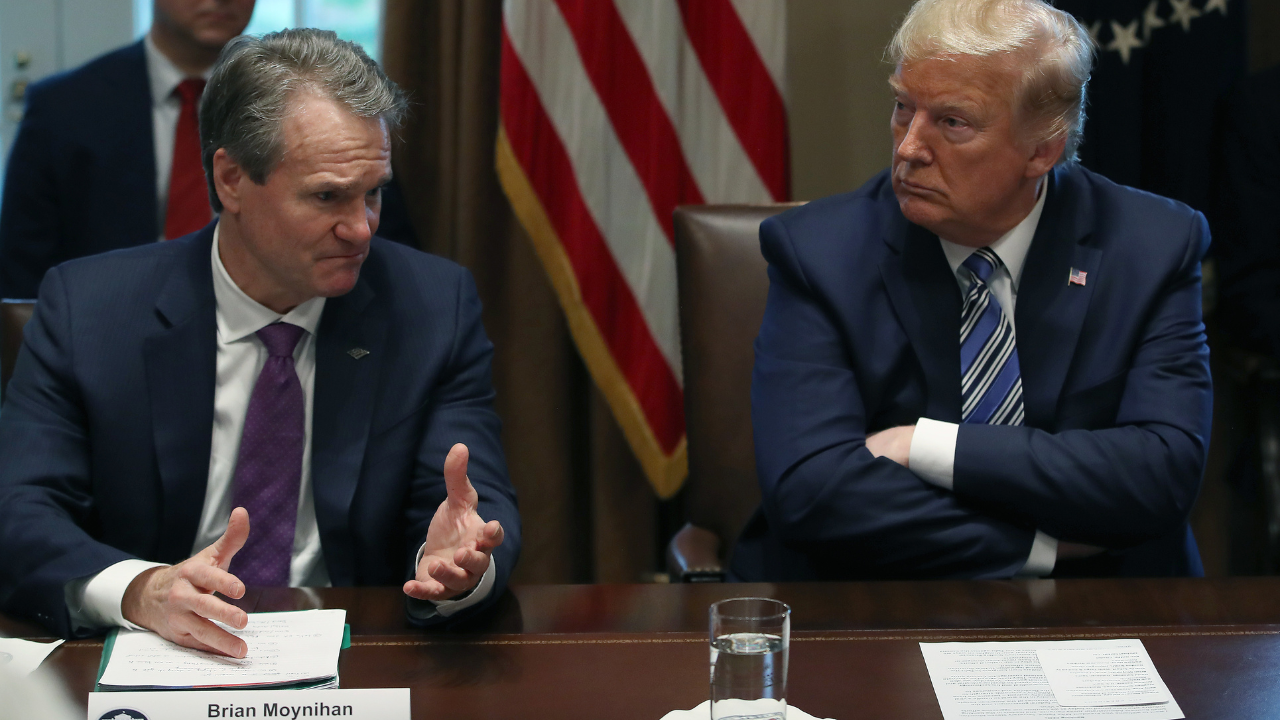
Photo Credit: U.S. President Donald Trump (R) listens to Bank of America CEO Brian Moynihan (L) speak during a meeting to discuss the coronavirus response in the Cabinet Room at the White House, on March 11, 2020 in Washington, DC. (Photo by Mark Wilson/Getty Images)