
“I love you, sir.” These are the words Todd Blanche uttered for Trump just after Pam Bondi was ousted and he assumed the top job at the Department of Justice.
Prior to joining the second Trump administration, Blanche built a rap sheet defending members of the Trump political orbit in legal crisis — including the President himself when he was indicted on 34 felony counts. He continued that role, though on the taxpayer’s dime, when he left New York for Washington in 2025 to become Deputy Attorney General and lead the handling of the Epstein files.
Despite political games of distraction and chaos, when the news cycle refused to relent on the Epstein files, Blanche’s boss lost her job and the Trump defender took her place — and quickly announced an end to the release of the files.
Developed through the research and reporting of Katie Chenoweth, Nina Burleigh, and Camaron Stevenson, this timeline pieces together court records, DOJ Epstein-file disclosures, and headlines over the years to trace how Trump’s personal lawyer landed the job managing the release of the Epstein files in Trump’s second administration.
A church in the living room touches off a years-long constitutional fight.
1985 marks the beginning of a years-long legal battle between Blanche’s father, Rev. Richard Blanche, and the city of Colorado Springs over the use of the family home for church services. The story eventually makes national headlines and winds up before the Colorado Supreme Court. As Nina Burleigh wrote for COURIER:
When Blanche was about ten, his father — Rev. Richard Blanche of Faith Bible Fellowship International — lost his church building and started hosting his flock at the family’s split-level ranch. Three or four times a week he set up folding chairs for 60 to 70 people in his living room and preached.
— Nina Burleigh, COURIER
The area is not zoned for such gatherings, and the city orders him to stop. Rev. Blanche does not take it lying down: he resists, drawing a six-month prison sentence, multiple fines and contempt charges. What began as a pro se zoning defense escalates into organized constitutional litigation backed by the nascent — now powerful — national religious-liberty legal groups.
The Supreme Court of Colorado denies Richard Blanche’s appeal, ending the family’s legal saga — though the case remains a cause célèbre for religious-liberty advocates.
The family settles in Baton Rouge; Todd enrolls at a Jimmy Swaggart school.
Blanche starts high school at Family Christian Academy, a K–12 school founded by televangelist Jimmy Swaggart. Earlier that year, Swaggart had delivered his famous “I have sinned” speech — a tearful televised confession of adultery. Blanche spends two years at Swaggart’s Pentecostal school, playing varsity basketball and baseball, before transferring to New Mexico Military Institute in Roswell, where he is voted “Distinguished New Cadet” his junior year.

Family Christian Academy · “Flames” yearbook
Three schools, a marriage at 20, and a degree from American University.
Blanche attends Louisiana State University as a freshman before transferring to Beloit College in Wisconsin, then — by 1994 — to American University in Washington, reportedly to be near Kristine, a Catholic University student he’d met on a trip to Australia. The pair marry soon after, when Blanche is 20. In 1996 he graduates with a B.A. in Communications, Legal Institutions, Economics & Government (CLEG) and Political Science.
According to college best friend Shane Hedges, Blanche wasn’t religious like his father: “He was very snarky and irreverent in the best possible way.” Their politics differed — Hedges was conservative, while Blanche “was a Democrat for a good chunk of his life.”
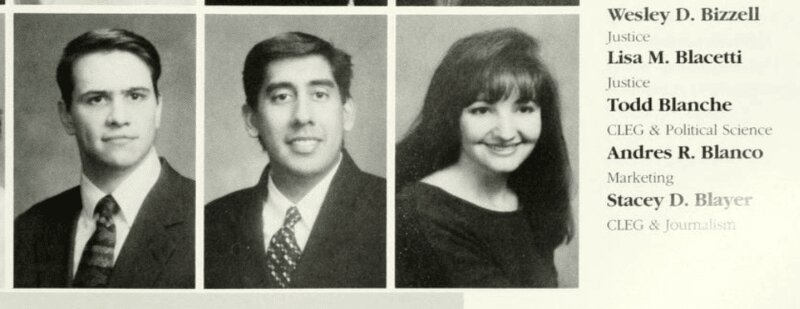
Per a questionnaire recently submitted to the Senate Judiciary Committee, Blanche’s first jobs out of college are at the Justice Department — first as a DynCorp contractor and legal analyst in the Asset Forfeiture & Money Laundering Section, then as a paralegal in DOJ’s Narcotics & Dangerous Drug Section.
Blanche works his way through evening classes at Brooklyn Law School while working as a paralegal at the U.S. Attorney’s Office in Manhattan.
A J.D. — and a firm with Epstein-adjacent clients.
Blanche earns his J.D. from Brooklyn Law School and joins the elite firm Davis Polk & Wardwell as an associate. The firm has represented individuals and entities close to Jeffrey Epstein, including Les Wexner and The Limited, Glenn Dubin, and JPMorgan.
Years after Blanche left, Epstein — then on house arrest in Palm Beach — attended a meeting at Davis Polk about his attempt to recover $150 million from the fund D.B. Zwirn. In 2019, the board of Wexner’s L Brands hired Davis Polk to investigate its CEO’s relationship with Epstein.
Source · DOJ
Eight years as a federal prosecutor at the Southern District of New York.
Blanche serves as Assistant U.S. Attorney at the SDNY, specializing in violent crime and narcotics prosecutions. In 2011 he is named Deputy Chief of the Criminal Division’s Violent Crimes Unit. He once described the job to a class of Manhasset, N.Y. high schoolers as “doing the right thing — making sure the bad guys go to jail and good guys don’t.”
Blanche leaves the U.S. Attorney’s Office to join Cadwalader, Wickersham & Taft, a venerable New York financial-services firm, becoming a partner in its Global Litigation Group.
Into Trump's Orbit
Representing Paul Manafort pulls Blanche into the Trump legal universe for the first time — the client relationship that reroutes the rest of his career.
The Manhattan District Attorney indicts Manafort on 16 counts of mortgage fraud and falsifying business records. Blanche serves as his attorney in the New York case and ultimately gets the charges dismissed.
A No. 2 at Justice intervenes to keep Manafort off Rikers Island.
Manafort is slated to be transferred to Rikers Island while awaiting arraignment. Blanche reportedly gets then-Deputy Attorney General Jeffrey Rosen to intervene; instead of Rikers, Manafort goes to the Metropolitan Correctional Center — where he briefly crosses paths with Jeffrey Epstein — then back to a low-security Pennsylvania prison. Manhattan DA Cy Vance’s office receives a letter from Rosen saying he’d be “monitoring” the detention, and lays into Blanche for going behind its back to the Bureau of Prisons.
Calling this highly unusual doesn’t even begin to capture how strange it is for the no. 2 official at DOJ to intervene in a state custody issue. https://t.co/oX8gXwPVs4
— Joyce Alene (@JoyceWhiteVance) June 17, 2019
“I think Mr. Manafort is a great man, I really do,” Blanche later said on a podcast. “He’s a client, of course, but he’s a friend.”
Igor Fruman — a former Rudy Giuliani associate who helped dig up dirt on Trump’s political rivals — pleads guilty to using Russian funds to make illegal campaign contributions. Blanche is his lawyer.
Trump hires Blanche to lead his hush-money defense.
After being indicted on 34 felony counts of falsifying business records to conceal payments to adult-film actress Stormy Daniels, Trump surrenders to the Manhattan DA’s office and hires Todd Blanche as lead counsel. Blanche resigns from Cadwalader to take the case, writing to colleagues in an email shared with Politico:
“I have been asked to represent Trump in the recently charged DA case… I have decided it is the best thing for me to do and an opportunity I should not pass up. Obviously, doing this as a partner at Cadwalader was not an option.“
— Todd Blanche, email to colleagues (Source)
In November 2023, Blanche and his wife purchase a $1.6 million house in Palm Beach County, near Mar-a-Lago.
Boris Epshteyn, Trump’s personal lawyer and a campaign adviser, is indicted in an Arizona case over the attempt to overturn Trump’s 2020 loss to Biden. Blanche is his lawyer.
Blanche and his family attend Trump’s Super Tuesday campaign celebration at Mar-a-Lago.
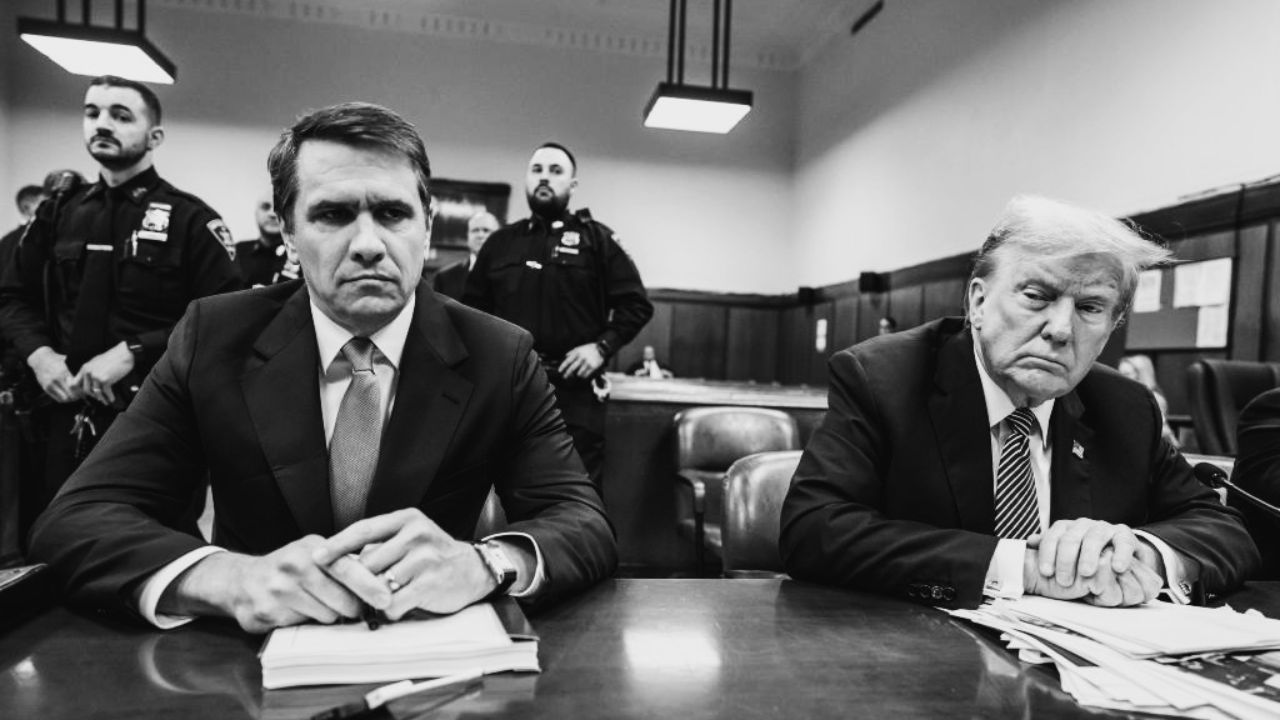
Trump’s criminal trial begins in Manhattan — with Blanche at his side.
Throughout the trial, Blanche is a fixture beside Trump for the daily press statements outside Manhattan Criminal Court.
Trump wins a second term — and names Blanche his Deputy AG.
Blanche is floated as a candidate for FBI Director, Deputy Attorney General, or White House Counsel. On November 14, 2024, Trump names him nominee for deputy attorney general.
Blanche moves to bury Jack Smith’s final report.
Days before the second inauguration, Blanche — still Trump’s personal attorney — sends Attorney General Merrick Garland a letter demanding Special Counsel Jack Smith not release his “Final Report,” accusing Smith of “bad faith” and of seeking to “lawlessly undermine the transition.” Smith replies that Trump’s team, given four days and using only two, had “not contested a single factual representation in the Report, instead objecting only to its public release,” and that the cases were dismissed solely because the Constitution bars prosecuting a sitting president.
Blanche appears on Trump’s behalf at his sentencing hearing in Manhattan, where Trump receives an unconditional discharge.
The Senate Judiciary Committee holds Blanche’s confirmation hearing. Democratic senators press him on the politicization of the Justice Department.
Blanche personally takes the FBI thumb drive of Epstein photos.
As Burleigh reported, Blanche personally takes possession of an FBI thumb drive containing all unsealed photos from the Epstein cases — materials the FBI said it had already provided to DOJ.
“There’s not a lot there.”
Per the New York Times, Blanche and Bondi brief Trump on the Epstein files; a decision is reached to release no further material, and Blanche helps FBI Director Kash Patel and others draft a memo explaining it.
“We’ve gone through the files,” Blanche told Trump. “There’s not a lot there. A lot of child pornography — obviously we can’t put any of that out. There are some mentions of you, but nothing substantive.“
— as reported by The New York Times
The Justice Department fires Maurene Comey, lead prosecutor in the Ghislaine Maxwell case.
Blanche floats interviewing Maxwell — and offers to do it himself.
At a Situation Room meeting to strategize about a Wall Street Journal story on a 2003 birthday letter from Trump to Epstein, Blanche reportedly suggests DOJ interview Ghislaine Maxwell. He offers to conduct the interview himself and raises the possibility that Maxwell’s lawyer — a personal friend of Blanche — might “expect something in return for her candor.”
Blanche attends another Situation Room meeting on a looming House subpoena of Epstein materials, assessing the files “he had personally reviewed or been briefed on, including a volume of child pornography.” The idea of a website to overwhelm the public with a massive database is floated — but never released.
Two days interviewing Ghislaine Maxwell — then a quiet prison transfer.
Over two days, Blanche interviews Maxwell. She says she witnessed no troubling behavior by Trump and doesn’t recall him sending the nude-drawing birthday card. Blanche closes by asking whether she knows where the Epstein “birthday book” is now. Soon after, Maxwell is quietly moved to a minimum-security prison camp in Texas — a transfer left unexplained until, five months later, Blanche says she’d faced “numerous threats against her life.”
“I’ve done countless interviews like this. Todd has done countless interviews like this… I know how to do it, and I know that Todd knows how to do it. And this is not it.“
— Elie Honig, former SDNY prosecutor, to CNN
After months of stalling by Republican leadership and the administration, the Epstein Files Transparency Act passes Congress and is signed by Trump.
Blanche takes the lead on reviewing — and redacting — the files.
A memo from his office instructs DOJ attorneys reviewing the files to flag several categories of information, including all FBI 302 reports summarizing interviews with victims and witnesses.
Straight to your inbox.
We cut through the noise with the headlines you need and the breakdowns you want — a skimmable weekly roundup of the Epstein investigation.
Subscribe to opt in to updates from COURIER
3 million pages — and a testy press conference.
Blanche holds a press conference announcing the release of 3 million pages of Epstein records. “I can assure that we complied with the statute and we complied with the act,” he tells reporters. “We did not protect President Trump or not protect anybody… there is a hunger or a thirst for information that I do not think will be satisfied by the review of these documents. And there is nothing I can do about that.”
Asked to speak directly to Epstein victims frustrated with the process, Blanche replies: “I do not know what you are speaking to. If there is frustration with the entire process, same here.” Pressed on whether the public will learn the identities of the men who abused the girls, he says: “You just baked in an assumption that I have never said… I do not think that the public or you all are going to uncover men within the Epstein files that abused women, unfortunately.”
Blanche and Bondi give a closed-door briefing on the files to the House Oversight Committee; Democratic members walk out within the hour, protesting that it’s being used to bypass a sworn deposition of Bondi. The same day, Sen. Ron Wyden writes Blanche asking why he intervened to block Wyden’s office from an unredacted memo on an Organized Crime Drug Enforcement task-force investigation into Epstein. (Blanche had appeared on Katie Miller’s podcast the day prior.)
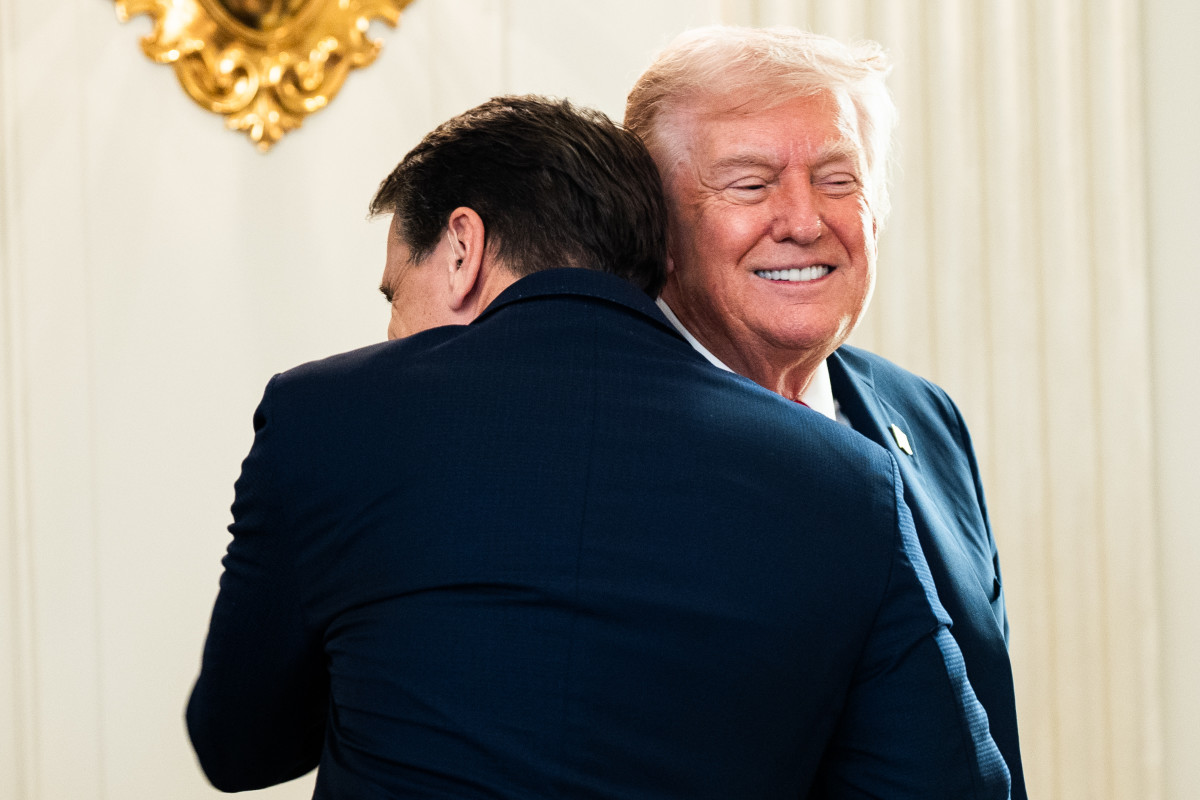
Trump fires Bondi. Blanche becomes Acting Attorney General.
Shortly after being named to the interim role, Blanche says:
“I did not ask for this job. I love working for President Trump. If he chooses to nominate somebody else and asks me to go do something else, I will say, ‘Thank you very much. I love you, sir.'”
— Todd Blanche, Acting Attorney General
Head of the DOJ
Trump’s personal defense lawyer is now Acting Attorney General — and one of his first acts is to halt any further release of the Epstein files.
“No more files” — then a walk-back.
On assuming the acting role, Blanche announces DOJ will release no additional files. Amid the backlash he tells NBC News: “The big misconception is that the Department of Justice or me has ever said ‘case closed.’ What we have said is that from the information we have within the Epstein files, we do not have a case against anybody.” The same week, the total paid by financial institutions, royals and Epstein associates to keep their involvement out of civil court surpasses $1 billion.
Independent journalist Katie Phang files suit in the U.S. District Court for the District of Columbia against Blanche, accusing him of violating the Epstein Files Transparency Act by not releasing the files in full.
Before the Senate Appropriations Committee, Blanche avoids Sen. Van Hollen’s request to commit that DOJ won’t recommend pardons for anyone in the Epstein files, and spars with Sen. Jack Reed over the Maxwell interview:
The same day, Blanche issues a directive granting Trump, his family, their companies and “affiliated individuals” immunity from ongoing IRS audits — and barring new IRS investigations into returns already filed.
Bondi points the finger — at Blanche.
Testifying before House Oversight, ousted AG Pam Bondi redirects nearly all criticism to her subordinates, casting Blanche as the one who handled the day-to-day Epstein investigation — including Maxwell’s transfer to a lower-security prison.
“Pam Bondi deflected to Todd Blanche over 30 times… we want to talk to Blanche. He was the one in charge of the redactions, in charge of the investigation. He has questions to answer.”
— Ranking Member Robert Garcia (Source)
In House testimony, Blanche does not commit to canceling the unprecedented audit and immunity protections granted to Trump and his family. On Sean Hannity’s “Hang Out” podcast the same day, he says Trump “absolutely” would have gone to prison had he lost the 2024 election.
A judge rules in Phang’s lawsuit that DOJ must either release additional files or explain why it won’t. When the deadline arrives, Blanche chooses the latter.
A judge refers Blanche to the New York bar.
U.S. District Judge Kathleen Williams issues a blistering ruling rebuking Trump’s lawsuit and referring Blanche to the New York bar. The same week, 101 lawyers and judges file a complaint to disbar the acting AG in New York.
Source · COURIER / courierny.com
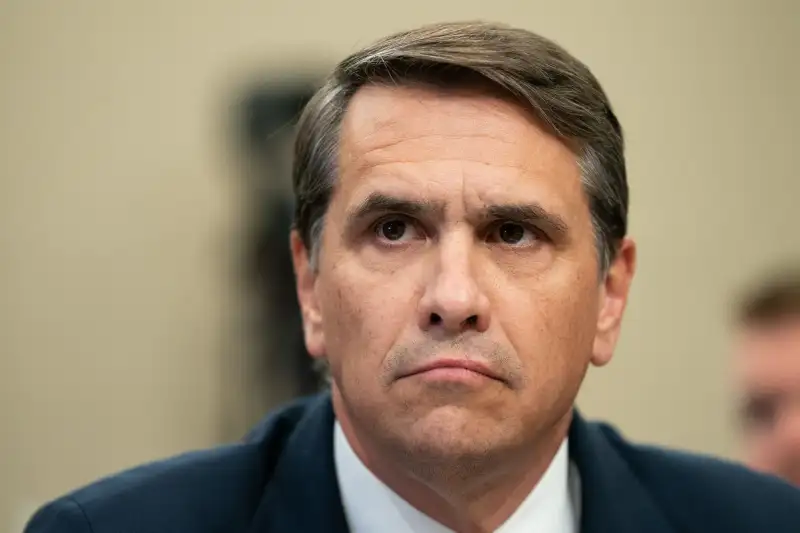
101 lawyers and judges file complaint to disbar acting AG Todd Blanche in New York
The coalition says Trump’s former personal attorney is illegally withholding Epstein files and running the DOJ to protect the president.
“I’m his lawyer.”
The Senate Judiciary Committee kicks off its two-day confirmation hearings for Blanche.
During the first day of the hearings, Senator Kennedy asked Blanche if he considers himself Trump’s friend. In a telling gaffe, Blanche replied: “I’m his lawyer.” Blanche was also pressed by Senator Dick Durbin to meet with the 10 Epstein survivors in the hearing room.
Blanche suggested that he was personally prohibited from meeting with survivors and instead offered to have them meet with one of his deputies.
“They have lawyers, as you know. I’m prohibited from meeting directly with them. I have met with counsel for survivors, as have many people in the Department of Justice. But if they are represented by counsel, we will work with their counsel.“
— Todd Blanche
Source · COURIER
A Republican senator won’t vote until Blanche meets survivors.
On day two, Republican Sen. Thom Tillis says he won’t vote for Blanche until Blanche meets with Epstein survivors — following survivor advocacy that included billboards before the Charlotte Motor Speedway exit on I-85.
Blanche schedules a 4 p.m. meeting the same day with survivors who’d sought to speak with him for months. A DOJ spokesperson calls it “productive”; survivor Liz Stein tells MSNOW otherwise:
“I didn’t expect to walk out of the meeting feeling the way we feel right now. It was demoralizing… It felt like more political posturing and using survivors the way we’ve been used as political pawns.“
— Liz Stein, Epstein survivor
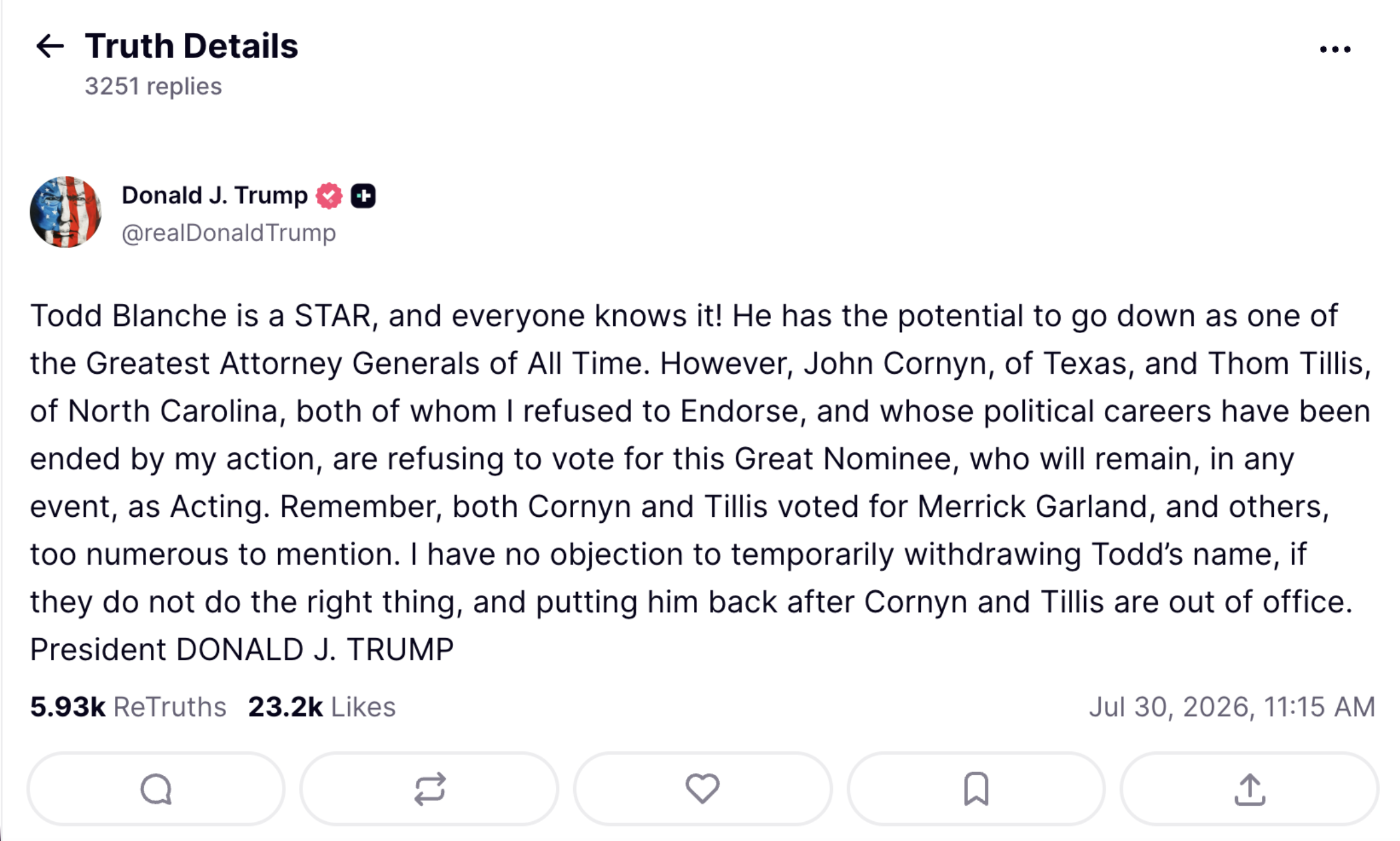
In light of hesitations from two outgoing Republican Senators, President Trump posts on Truth Social, “I have no objection to temporarily withdrawing Todd’s name, if they do not do the right thing, and putting him back after Cornyn and Tillis are out of office.”
Developed through the research and reporting of Katie Chenoweth, Nina Burleigh, and Camaron Stevenson for COURIER, drawing on court records, DOJ Epstein-file disclosures, and contemporaneous reporting.